amana portable air conditioner manual
Amana Portable Air Conditioner Manual: A Comprehensive Guide
This manual provides detailed instructions for Amana portable air conditioners, including models like the AP076E, covering installation, operation, maintenance, and troubleshooting.
Amana portable air conditioners offer a convenient cooling solution for individual rooms, without the need for permanent installation. These units are designed for ease of use and portability, allowing you to move cool air where it’s needed most. This manual serves as a comprehensive guide to understanding and operating your Amana portable AC, ensuring optimal performance and longevity.
Whether you’ve recently purchased an AP076E or another Amana model, this resource will walk you through setup, operation, and maintenance. You’ll find detailed instructions on window kit installation, control functions, cleaning procedures, and troubleshooting common issues. Proper use and care, as outlined in this manual, will maximize the efficiency and lifespan of your Amana appliance.
Understanding Your Amana Model (AP076E & Others)
Amana offers a range of portable air conditioner models, each designed to provide efficient and targeted cooling. While this manual provides general guidance applicable to most units, specific features and functionalities may vary. The AP076E, a popular choice, exemplifies Amana’s commitment to user-friendly design and reliable performance.
Familiarize yourself with the components of your specific model, including the control panel, remote control (if included), exhaust hose, and window kit. Understanding these elements is crucial for proper installation and operation. Refer to the diagrams and illustrations within this manual to identify each part. Knowing your model’s capabilities will allow you to optimize its cooling power and enjoy a comfortable indoor environment.
Safety Precautions & Warnings
To ensure safe operation and prevent potential hazards, carefully read and adhere to the following safety precautions. Always maintain a firm grip on the air conditioner cabinet during installation, especially when positioning it in a window. Never operate the unit with a damaged power cord or plug; Avoid using extension cords, as they may overheat.
Keep the unit away from flammable materials and water sources. Disconnect the unit from the power supply before cleaning or performing maintenance. Do not insert objects into the air vents. This appliance is not intended for use by persons (including children) with reduced physical, sensory, or mental capabilities, or lack of experience and knowledge, unless supervised.
Package Contents & Initial Inspection
Upon receiving your Amana portable air conditioner, carefully inspect the package for any signs of damage during transit. The package should include the air conditioner unit itself, a window kit (comprising curtain housings and guides), foam adhesive seals, a remote control, and this user manual.
Verify that all listed components are present. If any parts are missing or damaged, immediately contact customer support. Before initial use, remove all packaging materials, both inside and outside the unit. Ensure the air conditioner cabinet is free from any shipping debris. A thorough initial inspection will help guarantee proper functionality and prevent potential issues later on.
Installation Guide: Window Kit Setup
Proper window kit installation is crucial for efficient operation. Begin by selecting a suitable window that can accommodate the kit. Lower the window sash and position the air conditioner cabinet securely. Attach the curtain housings to the window frame, ensuring they are aligned correctly.
Next, install the curtain guides, sliding them into the housings. These guides will fill the gaps around the air conditioner. It’s vital the top channel is positioned inside the room. Secure everything with Phillips screws. Finally, double-check the cabinet’s tilt – a half-bubble level is ideal for proper drainage.
Curtain Housing & Guides Installation
Begin by attaching the curtain housings to the window frame; ensure a snug fit for optimal performance. Align the housings carefully, as misalignment can compromise cooling efficiency. Once positioned, slide the curtain guides into the housings, filling any gaps around the air conditioner cabinet.
These guides are essential for preventing warm air from re-entering the room. Pay close attention to the orientation – the top channel must face the interior of the room. Secure the housings and guides firmly, utilizing the provided hardware. A secure installation minimizes vibrations and maximizes cooling effectiveness.
Foam Adhesive Seal Application
To ensure an airtight seal and maximize cooling efficiency, carefully apply the foam adhesive seal to the window sash. This crucial step prevents warm air from bypassing the air conditioner and reduces energy consumption. Peel off the backing of the foam seal and firmly press it onto the window sash, focusing on areas surrounding the air conditioner cabinet.
Ensure complete contact between the foam and the window frame. Pay particular attention to corners and edges, as these are common areas for air leakage. A properly applied seal significantly improves the unit’s performance and overall cooling capability.
Securing the Air Conditioner Cabinet
After installing the window kit components, carefully position the Amana air conditioner cabinet within the window opening. Maintain a firm hold on the cabinet while lowering the window sash to securely hold it in place. It’s vital to ensure the cabinet is tilted slightly – approximately a half bubble – for proper drainage and optimal performance.
Use Phillips screws to further secure the cabinet to the window frame, providing additional stability. Regularly check the screws to confirm they remain tight. A secure installation prevents vibrations, reduces noise, and maximizes the unit’s cooling efficiency, ensuring long-lasting operation.
Operating Instructions: Basic Controls
Your Amana portable air conditioner features intuitive controls for effortless operation. The power button initiates or terminates the unit’s function. Once powered on, utilize the mode selection button to choose between cooling, fan-only, or dry operation. The temperature control allows precise adjustment of your desired room temperature, displayed digitally on the unit’s panel.
Fan speed can be adjusted to optimize airflow and comfort levels. Many models include a sleep mode for quieter operation during nighttime hours. Familiarize yourself with the control panel layout for quick and convenient adjustments. The remote control duplicates these functions for added convenience, allowing operation from across the room.
Mode Selection: Cool, Fan, Dry
Amana portable air conditioners offer versatile modes to suit your needs. The Cool mode actively lowers the room temperature, utilizing the compressor and fan to remove heat. Fan mode provides simple air circulation without cooling, ideal for ventilation. Select from multiple fan speeds for customized airflow. The Dry mode functions as a dehumidifier, reducing moisture levels in the air without significant temperature change.
Switching between modes is straightforward using the control panel or remote. Consider the room’s humidity and desired temperature when selecting a mode. Utilizing the appropriate mode optimizes energy efficiency and comfort. Experiment with each setting to determine the best configuration for your specific environment.
Temperature & Fan Speed Adjustment
Precisely control your comfort with Amana’s temperature and fan speed settings. Use the control panel or remote to adjust the desired room temperature, typically ranging from 60°F to 80°F (16°C to 27°C). Incremental adjustments allow for fine-tuning to your preference.
Fan speed offers multiple levels: Low, Medium, and High, or Auto. Auto mode intelligently adjusts fan speed based on the cooling demand. Higher fan speeds maximize airflow and cooling, while lower speeds minimize noise. Regularly adjusting these settings optimizes both comfort and energy consumption. Experiment to find the ideal balance for your environment and personal preference.
Using the Remote Control
The Amana remote control offers convenient, long-distance operation of your portable air conditioner. Ensure the remote has fresh batteries for optimal performance. Most functions mirrored on the unit’s control panel are accessible via the remote – power, mode selection (Cool, Fan, Dry), temperature adjustment, and fan speed control.
Direct the remote towards the air conditioner’s front panel for reliable communication. Utilize the ‘Sleep’ function for automated temperature adjustments during nighttime. The remote also allows for timer settings, enabling scheduled operation and energy savings. Keep the remote dry and avoid extreme temperatures for longevity.
Maintenance & Cleaning
Regular maintenance ensures optimal performance and extends the lifespan of your Amana portable air conditioner. Prioritize cleaning the air filter every two weeks, or more frequently in dusty environments, to maintain efficient airflow. A clogged filter reduces cooling capacity and increases energy consumption.
The cabinet can be wiped down with a damp cloth and mild detergent. Avoid abrasive cleaners that could damage the finish. Periodically check and empty the water reservoir (if applicable) to prevent overflow and mold growth. Proper drainage is crucial for dehumidifying modes. Always disconnect the unit from power before cleaning.
Filter Cleaning & Replacement
Maintaining a clean air filter is vital for efficient operation. Remove the filter, typically located on the rear of the unit, every two weeks or as needed based on usage. Gently vacuum the filter to remove dust and debris. For a more thorough cleaning, wash the filter with mild soap and water, ensuring it’s completely dry before reinstalling.
If the filter is damaged or excessively dirty, replacement is necessary. Use only Amana-approved replacement filters to ensure proper fit and performance. A dirty or damaged filter restricts airflow, reducing cooling efficiency and potentially causing the unit to overheat. Regularly checking and cleaning/replacing the filter optimizes performance.
Cabinet Cleaning
To maintain the appearance of your Amana portable air conditioner, regular cabinet cleaning is recommended. Before cleaning, always disconnect the unit from the power source. Use a soft, damp cloth to wipe down the exterior surfaces of the cabinet. Avoid using harsh chemicals, abrasive cleaners, or solvents, as these can damage the finish.
For stubborn stains, a mild soap solution can be used, followed by wiping with a clean, damp cloth to remove any residue. Ensure the cabinet is thoroughly dried after cleaning. Do not spray water directly onto the unit; instead, dampen the cloth. Regular cleaning prevents dust buildup and keeps your Amana air conditioner looking its best.
Drainage Procedures (If Applicable)
Some Amana portable air conditioner models may accumulate water during operation, particularly in dry mode. If your unit features a drainage port or tank, periodic emptying is necessary to prevent overflow and ensure optimal performance. Consult your specific model’s documentation to identify the drainage location;
Carefully remove the drainage plug or tank, allowing the water to drain completely into a suitable container. Replace the plug or tank securely after drainage. Avoid tilting the unit excessively during this process to prevent spillage. Regular drainage prevents water leaks and maintains the unit’s cooling efficiency.
Troubleshooting Common Issues
Encountering problems with your Amana portable air conditioner? This section addresses frequent concerns. If the unit isn’t cooling, check the filter for blockage and ensure the exhaust hose is properly connected and unobstructed. Water leaks often indicate improper drainage or a tilted unit – verify level placement and empty the drainage tank if applicable.
Error codes displayed on the unit’s panel signal specific malfunctions; consult the “Error Codes & Their Meanings” section for detailed explanations. Always disconnect the unit from power before attempting any troubleshooting steps. If issues persist, contact Amana customer support for assistance.
Air Conditioner Not Cooling
If your Amana portable AC isn’t cooling effectively, several factors could be at play. First, inspect the air filter; a clogged filter restricts airflow, reducing cooling capacity. Ensure the exhaust hose is securely connected to both the unit and the window kit, with no kinks or obstructions. Verify the window kit is properly sealed to prevent warm air from entering the room.
Also, confirm the unit is set to “Cool” mode and the desired temperature is lower than the room temperature. Check for error codes displayed on the unit, as these can pinpoint the issue. If problems persist, try resetting the unit by unplugging it for a few minutes.
Water Leaks & Drainage Problems
Water leaks from your Amana portable air conditioner often indicate a drainage issue. Ensure the unit is positioned on a level surface to facilitate proper condensation drainage. Regularly check and empty the water tank if your model has one; an overflowing tank is a common cause of leaks; If the unit has a continuous drainage option, verify the drain hose isn’t kinked or blocked and is correctly positioned for gravity drainage.
Inspect the connections around the water tank and drainage hose for any signs of looseness or damage. Proper window kit sealing is also crucial, as condensation can accumulate if warm air enters.
Error Codes & Their Meanings
Amana portable air conditioners utilize error codes to signal specific malfunctions. While specific codes vary by model, common errors include “E1” or “E2”, often indicating a sensor failure – potentially the temperature sensor. “E3” might signal a compressor issue, requiring professional service. “E4” could relate to a blocked evaporator or a refrigerant leak, also needing expert attention.
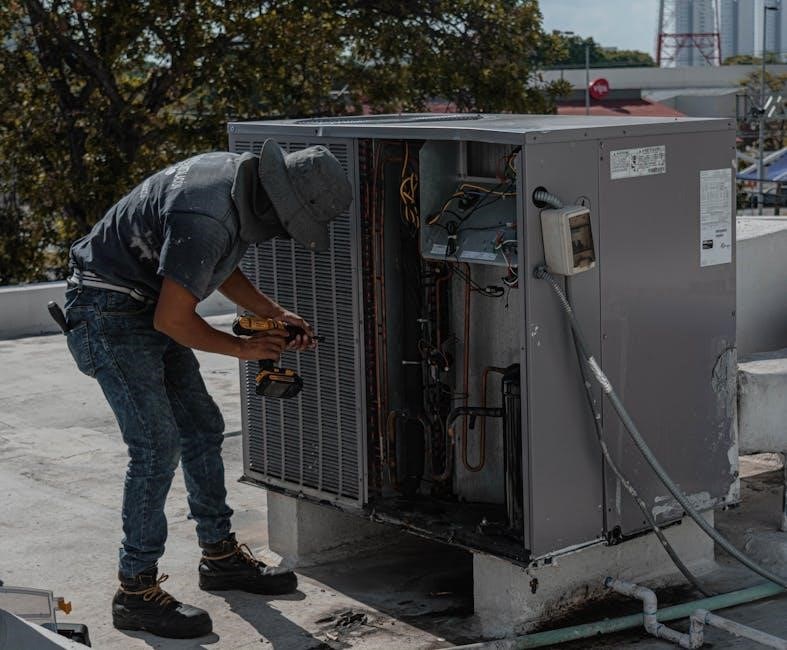
Consult your specific model’s documentation for a complete list of error codes and their corresponding solutions. Attempting repairs without proper knowledge can void your warranty and potentially damage the unit. If an error persists, contact Amana support for assistance.
Technical Specifications (AP076E Example)
The Amana AP076E portable air conditioner boasts a cooling capacity of 7,000 BTU, suitable for rooms up to 250 square feet. It operates on standard 115V/60Hz power, drawing approximately 6.5 amps. The unit’s refrigerant is R-410A, an environmentally friendlier alternative. Its dimensions are roughly 12.5” x 18.5” x 28.3”, with a weight around 44 pounds.
The AP076E features three fan speeds and adjustable temperature settings. Its dehumidification capacity is around 50 pints per day, and the water tank holds approximately 16.9 fl. oz. Noise levels typically range from 50-55 decibels on higher settings. These specifications may vary slightly depending on the manufacturing date.
Warranty Information & Support
Amana portable air conditioners typically come with a one-year limited warranty covering parts and labor for manufacturing defects. This warranty does not cover damage resulting from misuse, accidents, or improper maintenance. To initiate a warranty claim, retain your proof of purchase and contact Amana’s customer support.
For technical assistance, troubleshooting, or to locate authorized service centers, visit the Amana website or call their dedicated support line. Online resources, including FAQs and downloadable manuals, are readily available. Amana’s customer service aims to provide prompt and efficient assistance to ensure customer satisfaction with their products.
Disposal & Recycling Guidelines
Responsible disposal of your Amana portable air conditioner is crucial for environmental protection. Do not dispose of the unit with regular household waste. Instead, explore local recycling options for electronic waste (e-waste). Many communities offer designated collection events or facilities.
The air conditioner contains refrigerants and other components that require specialized handling. Improper disposal can harm the environment and potentially violate regulations. Contact your local waste management authority or an e-waste recycling center for guidance. Amana encourages environmentally conscious disposal practices to minimize its ecological footprint.
Frequently Asked Questions (FAQ)
Q: Why isn’t my Amana AC cooling? A: Ensure the filter is clean, the exhaust hose is properly connected, and the unit isn’t set to ‘Fan Only’ mode. Q: How often should I clean the filter? A: Clean the filter every two weeks for optimal performance. Q: What do I do about water leaks? A: Ensure proper drainage and the unit is level.
Q: What do error codes mean? A: Refer to the ‘Troubleshooting’ section for specific code definitions. Q: Can I use an extension cord? A: It’s not recommended; use a dedicated outlet. Q: How do I store the unit during the off-season? A: Drain all water and store in a dry place.